At first glance, the question “How many milligrams are in a millimeter?” might seem straightforward, but it actually highlights a common confusion between units of measurement. Milligrams (mg) measure mass, while millimeters (mm) measure length. These two units belong to entirely different dimensions and cannot be directly converted without additional context. However, this question often arises in scientific, industrial, and technological fields where precise measurements are critical, especially when dealing with LED displays and their specifications.
This article aims to clarify the fundamental differences between milligrams and millimeters, explain why they cannot be directly converted, and explore how LED displays use various measurements—including millimeters—to provide accurate information. By the end, readers will understand not only the nature of these units but also how LED technology leverages precise measurements to deliver optimal performance.
Understanding Units: Milligrams vs. Millimeters
What Is a Milligram?
A milligram (mg) is a unit of mass in the metric system. It is one-thousandth of a gram, which means 1 mg = 0.001 grams. Mass refers to the amount of matter contained in an object, and milligrams are commonly used in fields such as pharmacology, chemistry, and nutrition to measure very small quantities of substances.
For example, medication dosages often require milligram precision to ensure safety and effectiveness. A typical aspirin tablet might contain 325 mg of the active ingredient, indicating the mass of the substance present. In the realm of nutrition, milligrams are also used to quantify essential vitamins and minerals, such as iron and vitamin C, where even slight variations in dosage can significantly impact health outcomes. This precision is crucial for dietary supplements, where the balance of nutrients can affect absorption and overall efficacy.
What Is a Millimeter?
A millimeter (mm) is a unit of length in the metric system, equal to one-thousandth of a meter (1 mm = 0.001 meters). It is used to measure linear dimensions such as the thickness of a sheet, the diameter of a wire, or the size of a pixel on an LED display.
Millimeters are crucial in engineering, manufacturing, and design, where precise measurements ensure components fit together correctly and function as intended. For instance, the pixel pitch of an LED display is often measured in millimeters to indicate the distance between the centers of adjacent pixels. This measurement is vital for optimizing image resolution and clarity, especially in high-definition screens where every millimeter counts in delivering a sharp visual experience. Additionally, in the automotive industry, millimeters are used to specify tolerances in parts manufacturing, ensuring that even the smallest deviations can lead to performance issues or safety concerns.
Why Milligrams and Millimeters Are Not Directly Convertible
Milligrams and millimeters measure fundamentally different properties: mass and length, respectively. To convert between them, additional information about the material’s density or volume is necessary. For example, knowing the density of a substance (mass per unit volume) allows one to calculate mass from volume or length measurements, but without such data, the conversion is impossible.
In practical terms, asking how many milligrams are in a millimeter is like asking how many kilograms are in a meter—there is no direct answer unless the context specifies the material and its dimensions. This distinction is particularly important in scientific research and industrial applications, where accurate measurements are critical. For instance, in the pharmaceutical industry, understanding the relationship between the mass of a drug (in milligrams) and its volume (which could be measured in milliliters) is essential for formulating effective medications. Similarly, in manufacturing, knowing the dimensions of a component in millimeters can help determine the appropriate materials needed, ensuring that the final product meets the required specifications and standards.
LED Displays and the Role of Millimeters
What Are LED Displays?
LED (Light Emitting Diode) displays are electronic visual displays that use an array of tiny LEDs to produce images, text, and videos. They are widely used in advertising, information boards, televisions, and digital signage due to their brightness, energy efficiency, and long lifespan.
Understanding the physical dimensions of an LED display is critical for installation, image quality, and viewing experience. This is where millimeters come into play, particularly in measuring pixel pitch and screen size.
Pixel Pitch: The Key Measurement in Millimeters
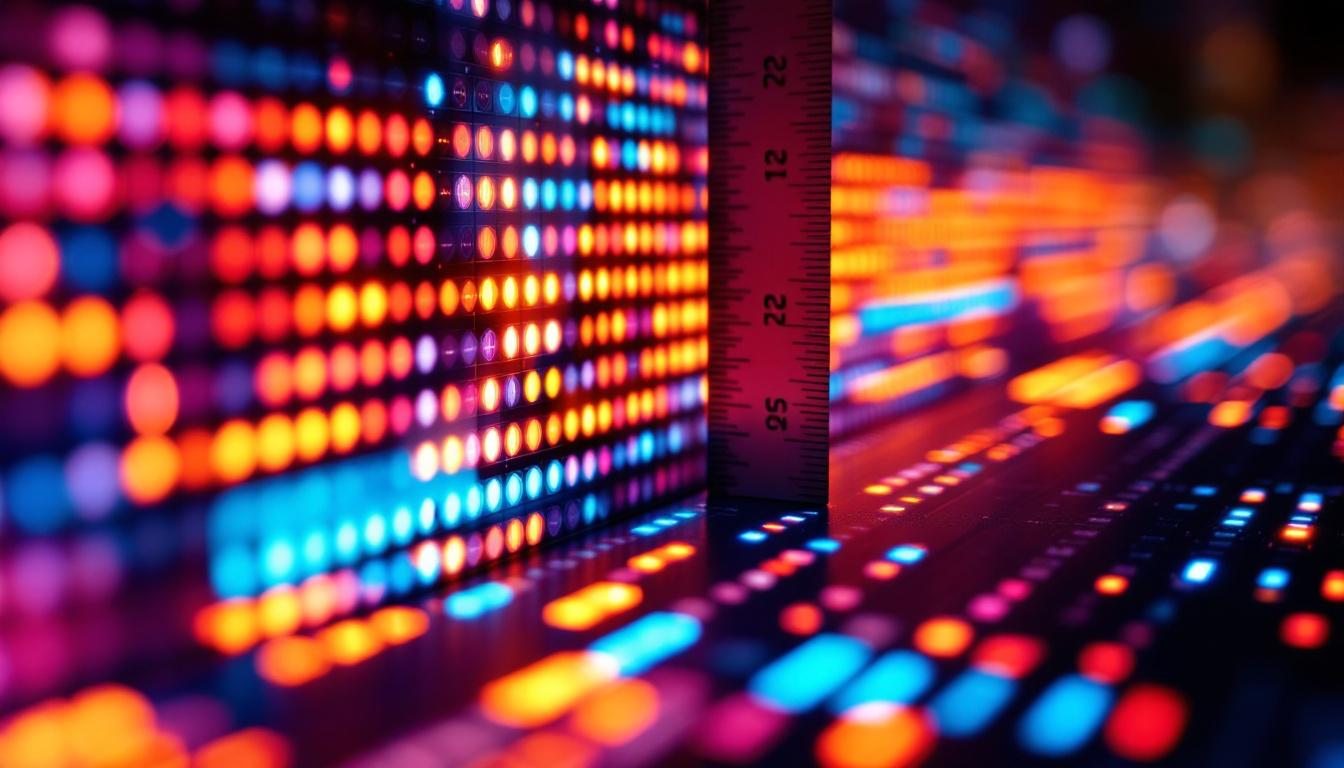
Pixel pitch refers to the distance from the center of one LED pixel to the center of the adjacent pixel, measured in millimeters. It is a vital specification because it determines the resolution and viewing distance of the display.
A smaller pixel pitch means more pixels per unit area, resulting in higher resolution and sharper images that can be viewed up close. Conversely, a larger pixel pitch suits displays intended for viewing from a distance, such as outdoor billboards.
For example, a pixel pitch of 1.5 mm indicates that the LEDs are spaced 1.5 millimeters apart. This tight spacing allows for detailed images on relatively small screens, making it ideal for indoor use in places like conference rooms or retail stores.
Display Size and Thickness
Millimeters also measure the physical size and thickness of LED panels. Manufacturers specify the height, width, and depth of each module in millimeters to help customers plan installation and ensure compatibility with existing structures.
For instance, an LED panel might measure 500 mm by 500 mm with a thickness of 50 mm. These precise measurements are essential for modular displays where multiple panels are combined to create large screens.
Mass Considerations in LED Displays: When Milligrams Matter
Why Mass Is Important in LED Technology
While millimeters dominate the discussion around LED displays, mass (measured in grams or milligrams) is also relevant, especially in manufacturing, shipping, and installation. Knowing the weight of LED components helps engineers design support structures and ensures safe handling.
For example, lightweight LED panels reduce the load on mounting systems and simplify installation. Advances in materials science have enabled manufacturers to produce panels weighing only a few kilograms, with individual components sometimes measured in milligrams for quality control.
Mass of LED Components
Individual LEDs are semiconductor devices that weigh only a few milligrams each. The precise mass of these components can affect thermal management and electrical performance. Engineers must account for the mass of LEDs, circuit boards, and protective materials to optimize the design.
Moreover, in high-volume production, tracking mass at the milligram level ensures consistency and reliability. Variations in component mass can indicate manufacturing defects or material inconsistencies.
Density and Material Properties
The relationship between mass and volume is governed by density, which is critical when designing LED display components. For example, the density of the substrate material affects the overall weight and durability of the display.
Understanding these properties allows manufacturers to select materials that balance strength, weight, and cost. This interplay between mass (milligrams or grams) and dimensions (millimeters) is essential for creating high-performance LED displays.
Bridging the Gap: Converting Between Mass and Length in Specific Contexts
When Conversion Is Possible
Although milligrams and millimeters measure different quantities, conversion becomes possible when the material’s density and geometry are known. For example, if an LED component is a rectangular block of known dimensions, its volume can be calculated in cubic millimeters. Multiplying this volume by the material’s density (in mg/mm³) yields the mass in milligrams.
Consider a small LED chip measuring 1 mm by 1 mm by 0.5 mm, made from a semiconductor with a density of approximately 5.32 mg/mm³. The volume is 0.5 mm³, so the mass would be roughly 2.66 mg (0.5 mm³ × 5.32 mg/mm³).
Practical Applications of Such Conversions
These calculations are essential in quality control, component design, and material sourcing. Engineers use them to estimate the weight of new designs, optimize thermal properties, and reduce material costs.
In LED manufacturing, precise mass-to-volume conversions help ensure that each component meets specifications, contributing to the overall reliability and performance of the display.
Common Misconceptions and Clarifications
Misunderstanding Units Leads to Errors
Mixing up milligrams and millimeters can cause significant errors in engineering and manufacturing. For example, confusing mass with length could lead to incorrect material estimates or faulty designs.
Clear communication and education about units are vital in technical fields. Using the correct units and understanding their meanings prevents costly mistakes and improves collaboration among teams.
Why Precision Matters in LED Displays
LED displays rely on precise measurements to deliver high-quality images. Pixel pitch in millimeters directly affects resolution, while the mass of components influences durability and ease of installation.
Ignoring these details can result in displays that are blurry, unstable, or difficult to maintain. Therefore, professionals must pay close attention to both dimensional and mass measurements.
Conclusion: Understanding Measurement Units in LED Technology
In summary, milligrams and millimeters serve distinct purposes—mass and length, respectively—and cannot be directly converted without additional information about material density and geometry. This distinction is crucial in fields like LED display manufacturing, where both types of measurements play essential roles.
Millimeters measure pixel pitch, panel size, and installation dimensions, directly influencing display quality and usability. Milligrams, on the other hand, relate to the mass of individual components and materials, affecting thermal management, structural integrity, and handling.
By understanding these units and their applications, engineers, designers, and consumers can make informed decisions about LED display technology. This knowledge ensures that displays meet performance expectations, are safe to install, and provide vibrant, clear visuals for a wide range of uses.
Explore Cutting-Edge LED Display Solutions with LumenMatrix
Now that you understand the importance of precise measurements in LED technology, take the next step with LumenMatrix. As a leader in innovative LED display solutions, we offer an extensive range of products designed to elevate your visual communication. From captivating Indoor and Outdoor LED Wall Displays to dynamic Vehicle and Sports LED Displays, our offerings are tailored to meet your unique needs. Discover how our Custom, All-in-One, and Transparent LED Displays can transform your space and engage your audience. Check out LumenMatrix LED Display Solutions today and experience the pinnacle of display technology.