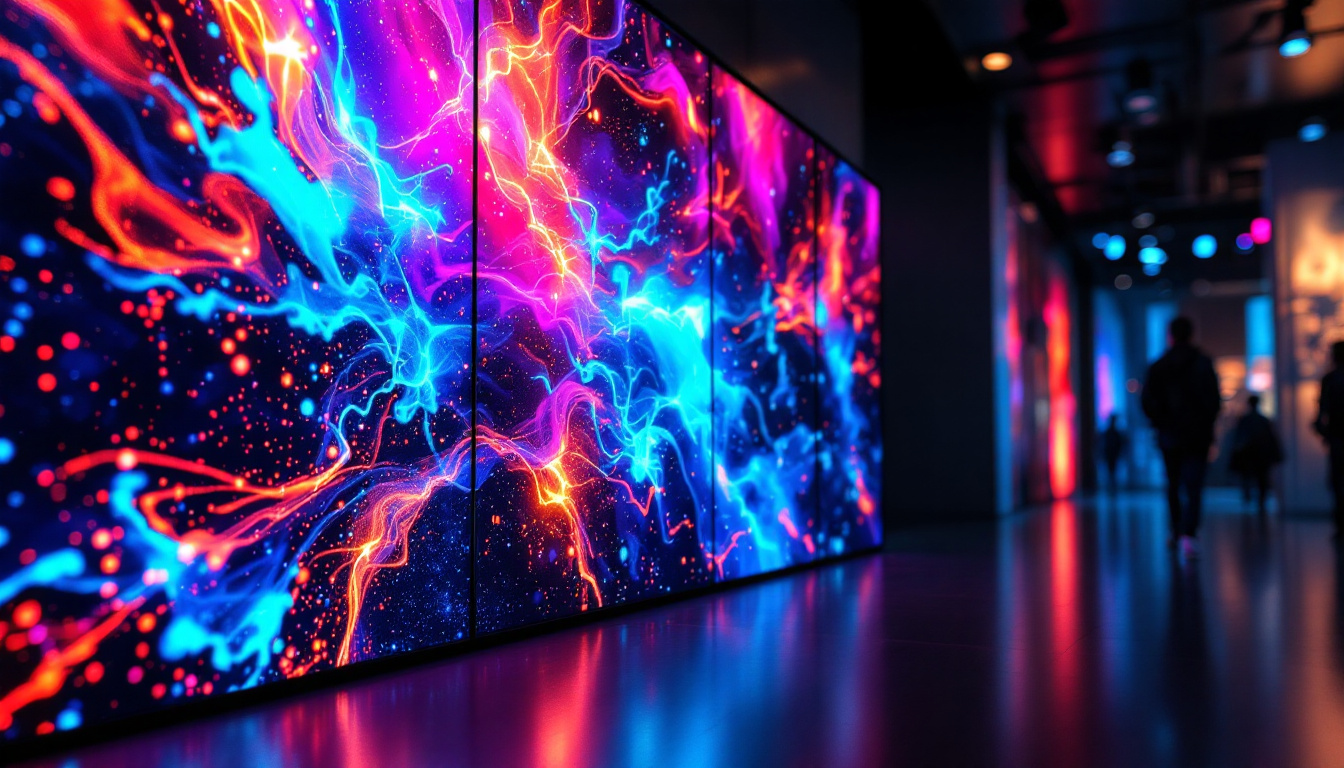
Matrix diagonalization is a fundamental concept in linear algebra with numerous applications across science, engineering, and technology. With the rise of computational tools, matrix diagonalization calculators have become invaluable for students, researchers, and professionals alike. One particularly fascinating application of matrices and their diagonalization is in the design and operation of LED displays. This article explores the principles behind matrix diagonalization calculators and delves into how these mathematical tools underpin the technology behind LED displays.
Understanding Matrix Diagonalization
Matrix diagonalization is the process of transforming a given square matrix into a diagonal matrix, which is a matrix where all the non-diagonal elements are zero. This transformation simplifies many matrix operations, making it easier to compute powers of matrices, solve systems of linear differential equations, and analyze linear transformations. The ability to diagonalize a matrix is a powerful tool in both theoretical and applied mathematics, allowing for greater insight into the behavior of linear systems.
What Is Matrix Diagonalization?
Formally, a matrix \( A \) is diagonalizable if there exists an invertible matrix \( P \) and a diagonal matrix \( D \) such that:
A = P D P^{-1}
Here, \( D \) contains the eigenvalues of \( A \) along its diagonal, and the columns of \( P \) are the corresponding eigenvectors. Diagonalization is only possible if the matrix has enough linearly independent eigenvectors to form \( P \). In practice, this means that not all matrices can be diagonalized; for instance, defective matrices, which lack a complete set of eigenvectors, cannot be transformed into diagonal form. Understanding the conditions under which a matrix is diagonalizable is essential for mathematicians and engineers alike.
Why Is Diagonalization Important?
Diagonalization simplifies many matrix computations. For example, calculating powers of a matrix \( A^n \) becomes straightforward when \( A \) is diagonalized:
A^n = P D^n P^{-1}
Since \( D \) is diagonal, raising it to the power \( n \) just involves raising each diagonal element to the power \( n \). This property is crucial in fields such as quantum mechanics, vibration analysis, and computer graphics. In quantum mechanics, for instance, the state of a quantum system can be represented by a vector in a complex vector space, and the evolution of this state can often be described using diagonalizable matrices, making calculations more efficient. Similarly, in vibration analysis, the natural frequencies of a system can be determined by diagonalizing the system’s stiffness and mass matrices, allowing engineers to predict the behavior of structures under dynamic loads.
Moreover, diagonalization plays a significant role in data science and machine learning, particularly in techniques like Principal Component Analysis (PCA). PCA relies on the diagonalization of the covariance matrix of a dataset to identify the directions (principal components) along which the data varies the most. By transforming the data into a diagonal form, researchers can reduce dimensionality while retaining the most informative features, thereby simplifying models and improving computational efficiency. This intersection of linear algebra and data analysis highlights the broad applicability of matrix diagonalization across various scientific disciplines.
The Role of Matrix Diagonalization Calculators
Manual diagonalization of matrices, especially large ones, can be tedious and error-prone. Matrix diagonalization calculators automate this process, providing quick and accurate results. These tools are widely used in academia and industry to facilitate complex computations.
Features of Matrix Diagonalization Calculators
Modern matrix diagonalization calculators offer several features that enhance usability and accuracy:
- Eigenvalue and Eigenvector Computation: Automatically compute eigenvalues and eigenvectors, the core components of diagonalization.
- Step-by-Step Solutions: Some calculators provide detailed steps, helping users understand the diagonalization process.
- Support for Various Matrix Sizes: Handle matrices ranging from 2×2 to much larger dimensions.
- Symbolic and Numeric Computations: Perform exact symbolic calculations or approximate numeric results.
- Export Options: Export results in formats suitable for reports or presentations.
How to Use a Matrix Diagonalization Calculator
Using a diagonalization calculator typically involves the following steps:
- Input the Matrix: Enter the square matrix elements into the calculator interface.
- Compute Eigenvalues and Eigenvectors: Trigger the calculation process.
- Obtain the Diagonal Matrix and Transformation Matrix: View the resulting diagonal matrix \( D \) and the invertible matrix \( P \).
- Interpret Results: Use the output for further analysis or applications.
These calculators are especially beneficial for those learning linear algebra or working on applied problems requiring matrix diagonalization.
LED Displays and Matrix Mathematics
LED (Light Emitting Diode) displays are ubiquitous in modern technology, ranging from simple digital clocks to large-scale video walls. The operation and control of these displays rely heavily on matrix mathematics, including diagonalization.
How LED Displays Work
At their core, LED displays consist of an array of tiny light sources arranged in rows and columns. Each LED can be individually controlled to emit light of varying intensity and color. The display’s image is formed by selectively activating these LEDs in patterns corresponding to the desired visual output.
Controlling an LED display involves managing the electrical signals that power each LED. This control is often represented mathematically as matrices, where each element corresponds to the state or brightness of an LED in the grid.
Matrix Representation of LED Displays
The LED array can be modeled as a matrix \( M \), where each element \( m_{ij} \) represents the brightness or color intensity of the LED at row \( i \) and column \( j \). Manipulating the display image is then equivalent to performing matrix operations on \( M \).
For example, transformations such as rotations, scaling, or filtering can be applied using matrix multiplication. These operations are essential in video processing and dynamic display effects.
Diagonalization in LED Display Control
Diagonalization becomes relevant when optimizing the control signals or analyzing the display’s behavior. For instance, the electrical characteristics of the LED matrix can be represented by matrices describing voltage, current, and resistance. Diagonalizing these matrices can simplify the analysis of the system’s response to input signals.
Moreover, in advanced LED display technologies, such as multiplexed displays, diagonalization helps in decomposing the control matrices into simpler components. This decomposition enables efficient driving schemes that reduce power consumption and improve display longevity.
Practical Applications: From Theory to LED Display Engineering
Understanding matrix diagonalization is not just an academic exercise; it has real-world implications in the design and operation of LED displays.
Optimizing LED Matrix Drivers
Matrix drivers are electronic circuits responsible for controlling the LED array. These drivers must handle complex signal patterns to render images accurately. By representing driver operations as matrices, engineers can use diagonalization to analyze and optimize the driver’s performance.
For example, diagonalization can identify independent modes of operation within the driver circuitry, allowing for targeted improvements and fault diagnosis.
Enhancing Display Resolution and Refresh Rates
Higher resolution and faster refresh rates demand efficient matrix computations. Diagonalization helps simplify these computations, enabling real-time processing of display data. This efficiency is critical in applications such as augmented reality (AR) and virtual reality (VR), where display responsiveness directly impacts user experience.
Power Management and Heat Dissipation
LED displays consume significant power, and managing this consumption is vital for device longevity and environmental considerations. Matrix diagonalization assists in modeling power distribution across the LED array, facilitating strategies to minimize hotspots and balance power loads.
By decomposing power matrices, engineers can design control algorithms that dynamically adjust LED brightness, reducing overall energy consumption without compromising display quality.
Using Matrix Diagonalization Calculators in LED Display Development
Matrix diagonalization calculators serve as essential tools throughout the LED display development lifecycle.
Design Phase
During design, engineers use diagonalization calculators to analyze electrical and thermal models of the LED array. This analysis informs decisions on component selection, layout, and cooling solutions.
Testing and Troubleshooting
In testing, diagonalization calculators help interpret measurement data by simplifying complex matrices representing system behavior. This simplification aids in pinpointing faults or inefficiencies within the display system.
Educational and Research Applications
For students and researchers, these calculators provide a hands-on approach to understanding the interplay between linear algebra and practical technology. They facilitate experimentation with matrix operations and their impact on LED display performance.
Choosing the Right Matrix Diagonalization Calculator
With numerous calculators available online and as software packages, selecting the right tool depends on specific needs.
Considerations for Selection
- Matrix Size and Complexity: Ensure the calculator can handle the dimensions and types of matrices relevant to your application.
- Accuracy and Precision: Look for tools that provide reliable results, especially when dealing with floating-point computations.
- User Interface: A clear, intuitive interface enhances usability, particularly for educational purposes.
- Additional Features: Step-by-step solutions, symbolic computation, and export options can be valuable.
- Integration: Consider whether the calculator integrates with other software used in LED display design or analysis.
Popular Matrix Diagonalization Calculators
Some widely used matrix diagonalization tools include MATLAB, Wolfram Alpha, and various open-source libraries such as NumPy (Python) and Eigen (C++). These tools offer robust capabilities for both numeric and symbolic matrix operations.
For quick calculations, web-based calculators provide accessible options without requiring installation. However, for large-scale or complex projects, dedicated software environments are preferable.
Conclusion
Matrix diagonalization calculators are powerful tools that bridge the gap between abstract mathematical theory and practical engineering applications. In the context of LED displays, understanding and applying matrix diagonalization enhances the design, control, and optimization of these ubiquitous devices.
From simplifying electrical models to improving power efficiency and display performance, diagonalization plays a crucial role in advancing LED technology. Leveraging matrix diagonalization calculators empowers engineers, researchers, and students to unlock the full potential of LED displays, driving innovation in this dynamic field.
As LED display technology continues to evolve, the integration of advanced mathematical tools like matrix diagonalization calculators will remain essential, ensuring that these vibrant displays meet the demands of tomorrow’s applications with precision and efficiency.
Explore Cutting-Edge LED Display Solutions with LumenMatrix
Ready to experience the next level of LED display technology? LumenMatrix is at the forefront of innovation, offering a wide range of LED display solutions that transform any space into a dynamic visual experience. Whether you need an Indoor LED Wall Display for your business, an Outdoor LED Wall Display for advertising, a Vehicle LED Display for mobile marketing, or even a Custom LED Display tailored to your unique requirements, LumenMatrix has the expertise to bring your vision to life. Embrace the power of advanced LED technology and make a lasting impression. Check out LumenMatrix LED Display Solutions today and see how we can help you communicate your message with unparalleled clarity and impact.