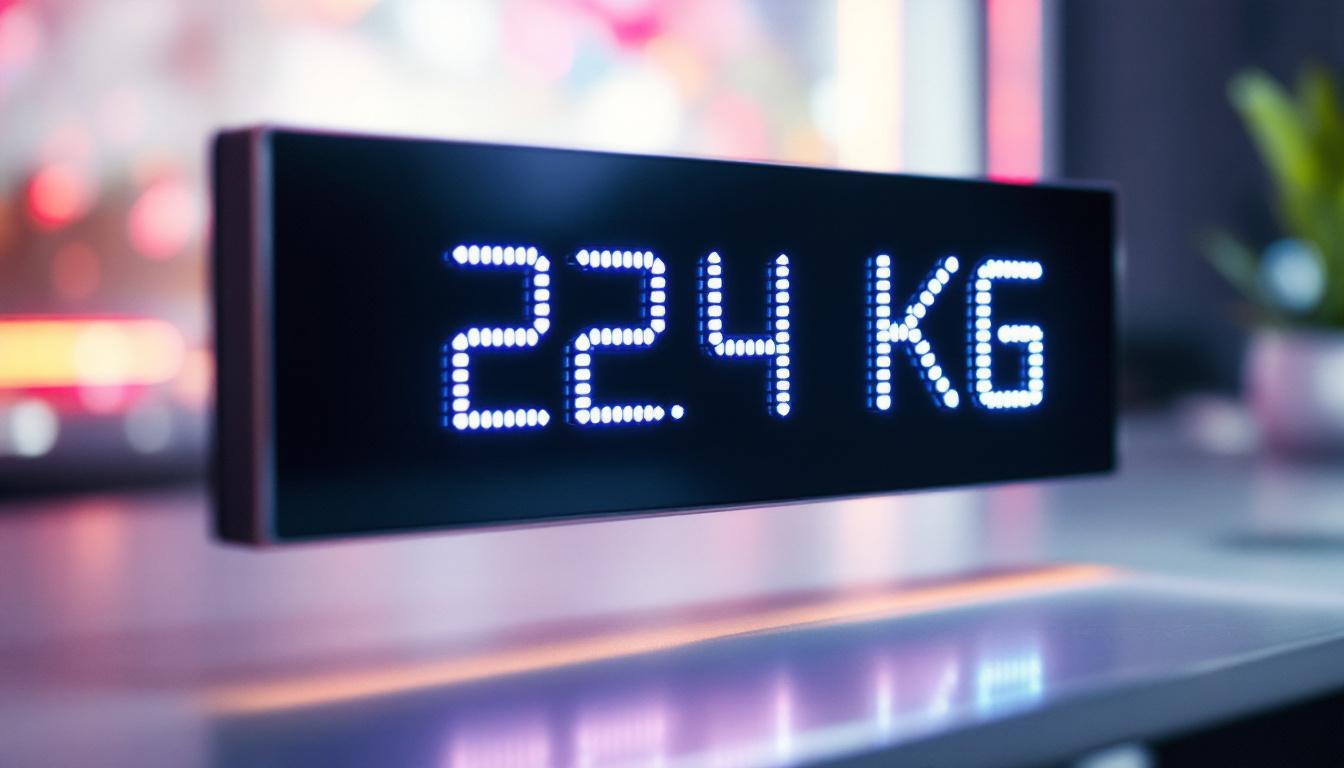
In a world where measurement conversions are commonplace, understanding how to convert kilograms (kg) to pounds (lbs) is essential. Whether you are dealing with shipping weights, fitness goals, or scientific data, knowing the exact conversion can make a significant difference. This article explores the conversion of 22.4 kilograms to pounds, while also delving into how LED displays present this information clearly and effectively. By the end, you will understand not only the conversion process but also how LED technology enhances readability and usability in various applications.
Understanding the Kilogram to Pound Conversion
What Is a Kilogram?
The kilogram is the base unit of mass in the International System of Units (SI). It is widely used around the world, especially in countries that follow the metric system. One kilogram is defined as the mass of the International Prototype Kilogram, a platinum-iridium alloy cylinder stored in France. This standard ensures consistency in measurement globally.
In practical terms, a kilogram is roughly equivalent to the mass of one liter of water at its maximum density. This makes it a convenient unit for everyday use, from grocery shopping to scientific experiments. The kilogram has also played a significant role in the history of measurement; its definition has evolved over time, transitioning from a physical object to a more precise definition based on fundamental constants of nature, such as the Planck constant. This shift reflects the ongoing quest for accuracy in scientific measurement, ensuring that the kilogram remains relevant in modern applications.
What Is a Pound?
The pound is a unit of mass commonly used in the United States and other countries that follow the imperial system. It is defined as exactly 0.45359237 kilograms. The pound is subdivided into 16 ounces, making it a familiar unit in many industries, including food, fitness, and logistics. The term “pound” has its roots in the Latin word “libra,” which refers to a balance or scale, highlighting the historical importance of weighing goods accurately.
Understanding pounds is crucial for those working in international contexts or dealing with products and data from countries using the imperial system. In the culinary world, for instance, recipes often specify ingredients in pounds, making it essential for chefs and home cooks alike to be able to convert measurements accurately. Additionally, in the fitness industry, weightlifting and body weight are frequently discussed in pounds, which can lead to confusion for individuals accustomed to the metric system. This underscores the importance of mastering conversions between these two systems to facilitate clear communication and understanding.
The Conversion Factor Between Kilograms and Pounds
To convert kilograms to pounds, the standard conversion factor is:
1 kilogram = 2.20462 pounds
This factor is precise and widely accepted, ensuring accuracy in conversions. Multiplying the mass in kilograms by 2.20462 will give the equivalent mass in pounds. Conversely, to convert pounds back to kilograms, one can divide the number of pounds by the same factor. This reciprocal relationship is useful in various fields, from engineering to nutrition, where precise weight measurements are critical.
Moreover, many online calculators and conversion tools are available to assist with these conversions, making it easier than ever to switch between kilograms and pounds. Understanding these conversions is not only beneficial for practical applications but also enhances one’s overall numeracy skills, allowing for greater confidence when dealing with measurements in diverse contexts. Whether you are traveling, cooking, or engaging in scientific research, being adept at converting between these units can significantly streamline your tasks and enhance your comprehension of global standards.
Converting 22.4 Kilograms to Pounds
Step-by-Step Conversion
To convert 22.4 kilograms to pounds, follow these steps:
- Start with the mass in kilograms: 22.4 kg
- Multiply by the conversion factor: 22.4 × 2.20462
- Calculate the result: 22.4 × 2.20462 = 49.4053 lbs
Therefore, 22.4 kilograms is approximately 49.41 pounds when rounded to two decimal places.
Practical Examples of 22.4 Kg in Pounds
Understanding this conversion can be useful in many real-world scenarios. For example, a 22.4 kg suitcase would weigh about 49.4 lbs, which is important information when checking airline baggage limits. Similarly, a 22.4 kg dumbbell translates to nearly 50 lbs, a common weight in fitness training.
Such conversions help bridge the gap between metric and imperial systems, facilitating communication and decision-making across different regions and industries.
How LED Displays Present Weight Conversions
The Role of LED Displays in Measurement Devices
LED (Light Emitting Diode) displays are widely used in modern measurement devices such as digital scales, fitness trackers, and industrial equipment. Their bright, clear output makes it easy to read numerical data in various lighting conditions, which is essential for accuracy and user convenience.
When displaying weight conversions like 22.4 kg to lbs, LED displays often provide instant, real-time feedback, allowing users to switch between units seamlessly.
Advantages of LED Displays for Weight Measurement
LED displays offer several benefits:
- Visibility: High brightness and contrast ensure numbers are visible even in bright sunlight or dim environments.
- Energy Efficiency: LEDs consume less power than traditional display technologies, extending battery life in portable devices.
- Durability: LED displays are robust and resistant to shock and vibration, making them ideal for industrial and outdoor use.
- Customization: They can display multiple units, symbols, and graphical elements, enhancing user interaction and understanding.
Example: Digital Scales with LED Displays
Digital scales often incorporate LED displays to show weight in kilograms, pounds, or both. Users can toggle between units with a simple button press, and the display updates instantly. For example, placing a 22.4 kg object on the scale will show “22.4 kg” initially and then “49.41 lbs” when switched to pounds.
This feature is particularly useful in international shipping, where packages may be weighed in kilograms but labeled in pounds, or vice versa.
Applications and Importance of Accurate Weight Conversion
Logistics and Shipping
In the logistics industry, precise weight measurement and conversion are critical for calculating shipping costs and ensuring compliance with carrier regulations. Many international shipping companies use kilograms as their standard unit, while others prefer pounds. Accurate conversion helps avoid costly errors and delays.
For example, a package weighing 22.4 kg must be correctly converted to 49.41 lbs to meet the requirements of carriers using imperial units. LED displays on weighing scales facilitate this process by providing immediate, easy-to-read conversions.
Health and Fitness
In health and fitness, weight tracking is fundamental for monitoring progress and setting goals. Gym equipment, personal scales, and fitness apps often allow users to switch between kilograms and pounds depending on their preference or location.
Knowing that 22.4 kg equals approximately 49.41 lbs helps individuals understand their weight in familiar terms, enhancing motivation and clarity.
Science and Education
Scientific experiments and educational settings frequently require precise unit conversions. Students and researchers must convert between metric and imperial units to interpret data correctly and communicate findings internationally.
LED displays on laboratory scales and measurement devices provide accurate, real-time conversions, reducing the risk of errors and improving learning outcomes.
Ensuring Accuracy in LED Display Conversions
Calibration of Devices
For LED displays to show accurate weight conversions, the underlying measurement devices must be properly calibrated. Calibration involves adjusting the scale to known standards to eliminate errors caused by wear, environmental factors, or manufacturing variances.
Regular calibration ensures that when a weight like 22.4 kg is placed on the scale, the LED display shows the correct equivalent in pounds without discrepancies.
Software and Firmware Precision
Modern digital scales use embedded software to perform unit conversions. The precision of these calculations depends on the algorithms and the number of decimal places used.
High-quality devices use conversion factors with sufficient decimal precision (e.g., 2.20462) and round results appropriately to maintain accuracy. This is particularly important for weights like 22.4 kg, where small rounding errors can accumulate in bulk calculations.
User Interface Design
The design of the LED display interface also impacts how users perceive and utilize weight conversions. Clear labeling of units, intuitive buttons for switching units, and readable fonts all contribute to a positive user experience.
For example, an LED display that clearly shows “22.4 kg” alongside “49.41 lbs” helps users quickly understand the conversion without confusion.
Future Trends in Weight Measurement and Display Technologies
Integration with Smart Devices
Weight measurement devices are increasingly integrating with smartphones and other smart devices via Bluetooth or Wi-Fi. This connectivity allows users to track weight data over time, convert units automatically, and receive personalized insights.
LED displays on these devices continue to play a crucial role by providing immediate feedback before data is transmitted to apps for further analysis.
Advancements in Display Technology
While LED displays remain popular, emerging technologies like OLED (Organic LED) and microLED offer even better contrast, thinner designs, and lower power consumption. These advancements will enhance the readability and functionality of weight measurement devices in the future.
Such improvements will make conversions like 22.4 kg to lbs even easier to read and interpret in various environments.
Enhanced Precision and Automation
Automation in weighing and conversion processes is growing, with devices capable of automatically detecting the unit system and converting weights without user input. This reduces human error and streamlines workflows in industries ranging from manufacturing to healthcare.
LED displays will continue to provide the visual interface for these automated systems, ensuring users have clear, accurate information at their fingertips.
Conclusion
Converting 22.4 kilograms to pounds results in approximately 49.41 lbs, a conversion that is simple yet vital across many fields. LED displays play an essential role in presenting this information clearly, accurately, and efficiently, whether on digital scales, fitness equipment, or industrial devices.
Understanding both the mathematical conversion and the technology behind LED displays enhances the ability to work confidently with weight measurements in different units. As technology advances, these displays will become even more integral to ensuring precision and usability in weight measurement and conversion.
Whether for personal use, professional applications, or scientific research, mastering the conversion of kilograms to pounds and appreciating the role of LED displays empowers users to make informed decisions and communicate effectively across measurement systems.
Discover LumenMatrix’s Advanced LED Display Solutions
As you’ve seen, accurate weight conversions and clear displays are crucial in many aspects of daily life. LumenMatrix is at the forefront of LED display technology, offering a wide array of solutions that cater to your specific needs. From enhancing your brand’s visibility with an Indoor LED Wall Display to creating dynamic visual experiences with a Custom LED Display, LumenMatrix has the expertise to bring your vision to life. Don’t let your message get lost in translation; instead, captivate your audience with precision and brilliance. Check out LumenMatrix LED Display Solutions today and take the first step towards transforming your visual communication.