In the ever-evolving world of visual technology, 3D cube LED displays have emerged as a captivating medium for showcasing dynamic content in three dimensions. These displays combine the principles of LED technology with innovative spatial arrangements to create immersive visual experiences that transcend traditional flat screens. This article explores the fundamentals of 3D cube LED displays, their technological framework, applications, and future potential.
Understanding the Basics of LED Displays
What is an LED Display?
LED, or Light Emitting Diode, displays are screens composed of numerous tiny light sources that emit light when electrically stimulated. Unlike LCD or OLED screens, LED displays utilize discrete diodes to create images, offering advantages such as higher brightness, energy efficiency, and longer lifespan. These qualities make LED displays ideal for both indoor and outdoor environments, where clarity and durability are paramount. The versatility of LED technology allows it to be used in a variety of applications, from large-scale billboards and stadium screens to smaller devices like smartphones and televisions, catering to a wide range of consumer needs.
How LED Technology Works
At the core of an LED display are individual diodes that emit red, green, or blue light. By adjusting the intensity of each diode, the display can produce a full spectrum of colors. These diodes are arranged in a grid pattern, and the combined light output forms the images or videos seen on the screen. The refresh rate, pixel pitch, and resolution are critical parameters that determine the display’s quality and performance. Furthermore, advancements in LED technology have led to the development of smart displays that incorporate sensors and connectivity features, allowing for real-time data integration and interactive experiences. This evolution not only enhances the user experience but also opens up new avenues for advertising and information dissemination.
From Flat to 3D: The Evolution
Traditional LED displays are flat panels, but advances in design and control technology have enabled the creation of three-dimensional LED structures. By arranging LEDs in a volumetric format, such as a cube, it becomes possible to display content that occupies physical space, offering viewers a more engaging and realistic experience. This shift from 2D to 3D LED displays represents a significant leap in digital visualization. Additionally, the integration of augmented reality (AR) and virtual reality (VR) with LED technology is paving the way for immersive environments where users can interact with digital content in a more intuitive manner. As these technologies converge, the potential applications in fields such as entertainment, education, and advertising are virtually limitless, promising to transform how we perceive and engage with visual information.
The Structure and Technology Behind 3D Cube LED Displays
Design and Construction of 3D LED Cubes
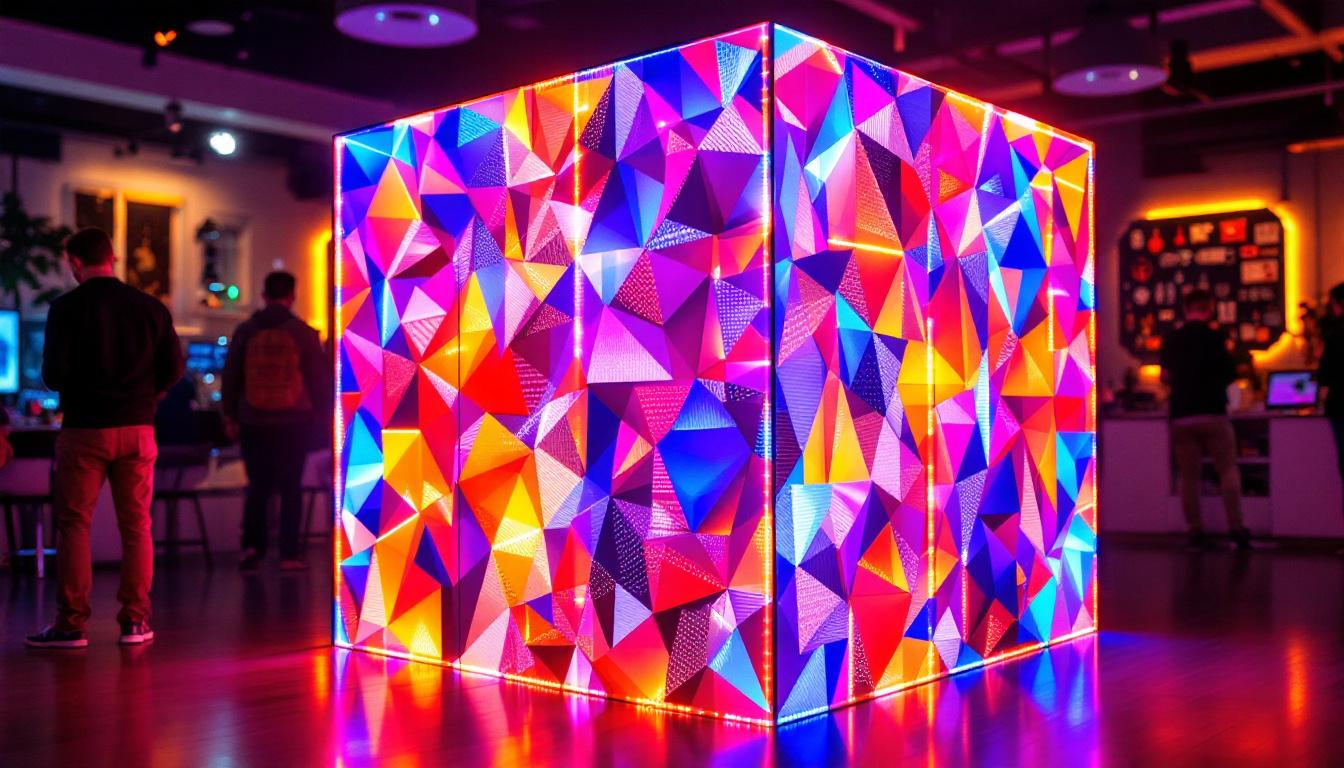
A 3D LED cube display typically consists of multiple layers or planes of LEDs arranged in a cubic lattice. For example, a common configuration might be an 8x8x8 cube, which contains 512 individual LEDs. These LEDs are mounted on a framework that allows for precise control of each light source in three dimensions. The cube’s structure is designed to maximize visibility from multiple angles, enhancing the immersive effect. The choice of materials for the framework is also crucial; lightweight yet sturdy materials such as aluminum or acrylic are often used to ensure durability without compromising the display’s portability. The arrangement of LEDs can vary, with some cubes employing RGB LEDs to create a full spectrum of colors, allowing for vibrant displays that can captivate audiences.
Control Systems and Programming
Operating a 3D LED cube requires sophisticated control electronics and software. Microcontrollers or specialized LED drivers manage the on/off state and brightness of each LED in real-time. Programming languages such as C++ or Python are often used to create animations and interactive effects. The software must handle complex timing and synchronization to ensure smooth motion and accurate representation of 3D objects within the cube. Additionally, many developers utilize libraries and frameworks specifically designed for LED control, such as FastLED or NeoPixel, which simplify the programming process and enhance functionality. The integration of sensors, such as accelerometers or touch sensors, can further elevate the user experience by allowing for interactive displays that respond to viewer movements or inputs, making the cube not just a visual spectacle but an engaging piece of technology.
Challenges in 3D LED Cube Development
Building a 3D LED cube involves overcoming several technical challenges. Heat dissipation is a concern due to the density of LEDs, requiring efficient thermal management solutions. Power consumption must be optimized to prevent excessive energy use while maintaining brightness. Additionally, ensuring uniform brightness and color consistency across all LEDs is critical for visual coherence. Advances in LED manufacturing and control algorithms continue to address these issues. Moreover, the physical constraints of the cube’s size can limit the complexity of the visuals produced; developers must creatively design animations that fit within the spatial limitations while still delivering an impactful experience. As technology progresses, innovations such as wireless control and enhanced pixel density are paving the way for more sophisticated displays, allowing for even greater creativity and interactivity in 3D LED cube designs.
Applications of 3D Cube LED Displays
Advertising and Marketing
3D LED cubes offer a novel platform for brands to capture attention in crowded environments. Their ability to display eye-catching animations and volumetric visuals makes them ideal for retail stores, trade shows, and public spaces. For instance, a 3D cube display can showcase a rotating product model or dynamic logos, creating a memorable brand presence that stands out from conventional 2D signage. Moreover, the interactivity of these displays can further enhance customer engagement; potential buyers can interact with the visuals, rotating or zooming in on products, which can lead to increased interest and sales. Brands can also leverage augmented reality features, allowing customers to visualize products in their own environments through their smartphones, seamlessly blending the physical and digital worlds.
Educational and Scientific Visualization
In educational settings, 3D LED cubes serve as powerful tools for visualizing complex data and concepts. They can represent molecular structures, mathematical functions, or physical phenomena in a tangible form. Scientific institutions and museums use these displays to engage audiences by providing interactive experiences that deepen understanding through spatial representation. For example, students can manipulate a 3D model of the solar system, adjusting the scale and rotation to better grasp the vastness of space and the relative positions of planets. Additionally, researchers can utilize these displays to present their findings in a more digestible format, allowing for real-time data manipulation and visualization that can facilitate discussions and enhance collaborative learning.
Entertainment and Art Installations
Artists and performers have embraced 3D LED cubes as a medium for creative expression. The cubes can be programmed to respond to music, motion, or audience interaction, creating immersive installations and performances. This fusion of technology and art pushes the boundaries of visual storytelling, offering audiences unique sensory experiences. In contemporary art galleries, for instance, artists can create dynamic visual narratives that change with the viewer’s movement, making each visit a unique experience. Additionally, in live performances, such as concerts or theater productions, these displays can serve as a backdrop that evolves in real-time, enhancing the emotional impact of the performance and drawing the audience deeper into the narrative. The versatility of 3D LED cubes opens up endless possibilities for collaboration between technology and the arts, inspiring a new generation of creators to explore this innovative medium.
Future Trends and Innovations in 3D LED Cube Displays
Integration with Augmented and Virtual Reality
The convergence of 3D LED cubes with augmented reality (AR) and virtual reality (VR) technologies is an exciting frontier. By combining physical LED structures with AR overlays, users can experience enhanced interactive environments where digital and real-world elements coexist. This integration opens new possibilities for gaming, training simulations, and collaborative design. For instance, in the field of education, students can interact with 3D models of complex biological structures or historical artifacts, allowing for a more immersive learning experience. Similarly, architects and designers can visualize their projects in real-time, manipulating virtual elements within a physical space, thereby improving collaboration and decision-making processes.
Advancements in Miniaturization and Resolution
Ongoing improvements in LED miniaturization are enabling higher resolution 3D cubes with more LEDs packed into smaller volumes. This increase in pixel density allows for finer detail and smoother animations, making the displays more lifelike. Such advancements also reduce the physical footprint of the cubes, making them more versatile for various applications. As a result, industries like advertising and entertainment are beginning to adopt these compact displays for immersive experiences in smaller venues, such as pop-up events or interactive installations. Furthermore, the ability to create custom shapes and sizes means that businesses can tailor their displays to fit unique environments, enhancing the overall impact of their visual communications.
Energy Efficiency and Sustainability
As environmental concerns grow, the development of energy-efficient LED components and power management systems is gaining importance. Innovations such as low-power LEDs, adaptive brightness controls, and recyclable materials contribute to making 3D LED cube displays more sustainable. These efforts align with broader industry trends toward greener technology solutions. Additionally, manufacturers are exploring the use of organic light-emitting diodes (OLEDs) and other alternative technologies that promise even greater energy efficiency and lower environmental impact. The shift towards sustainable practices not only helps in reducing carbon footprints but also appeals to eco-conscious consumers, making these displays a more attractive option for businesses looking to enhance their corporate social responsibility initiatives.
Conclusion
3D cube LED displays represent a remarkable fusion of technology, design, and creativity. By transforming the traditional flat LED screen into a volumetric, interactive medium, these displays offer new dimensions of visual communication. Their applications span marketing, education, entertainment, and beyond, with ongoing innovations promising even greater capabilities in the near future. As LED technology continues to advance, 3D LED cubes are poised to become a staple in the landscape of immersive digital experiences.
Explore the Future of Visual Communication with LumenMatrix
Ready to elevate your visual storytelling and captivate your audience with the latest in LED display technology? LumenMatrix is at the forefront of creating immersive, high-resolution LED displays that transform any space into a dynamic visual experience. From Indoor and Outdoor LED Walls to innovative solutions like Vehicle Displays, LED Posters, and Transparent Displays, our products are designed to bring your vision to life with unparalleled clarity and impact. Don’t just take our word for it; check out LumenMatrix LED Display Solutions and see how we can help you make a lasting impression in the world of digital signage.