In the evolving world of digital visualization, LED technology stands out as a transformative force. Among its many applications, the LED cube display has captured the imagination of hobbyists, engineers, and designers alike. Combining three-dimensional lighting with programmable control, LED cubes offer a unique way to visualize data, create art, and enhance interactive experiences.
This article delves into the fundamentals of LED cube displays, exploring their construction, operation, and diverse applications. Whether you are a technology enthusiast, a professional in display technology, or simply curious about how these captivating devices work, this comprehensive guide will illuminate the subject with clarity and depth.
Understanding the Basics of LED Cube Displays
What Is an LED Cube Display?
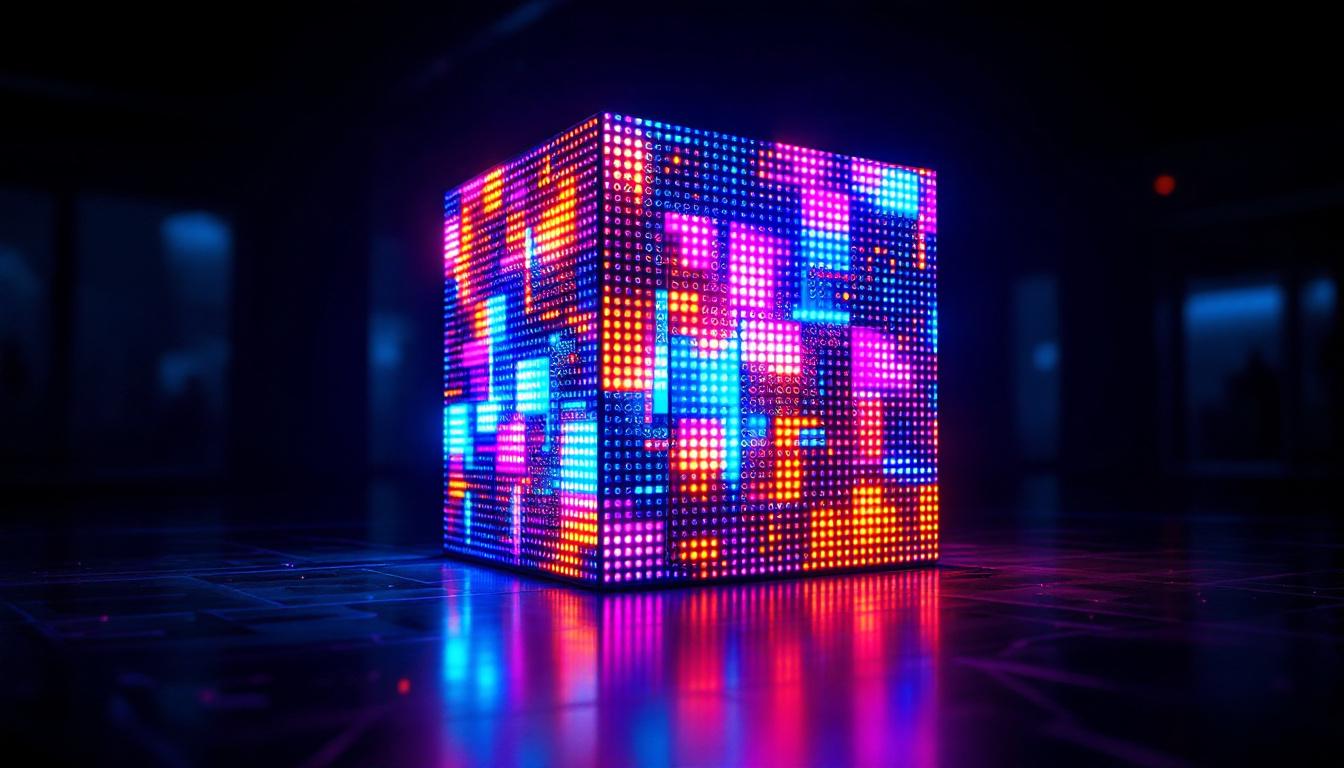
An LED cube display is a three-dimensional array of light-emitting diodes (LEDs) arranged in a cubic matrix. Unlike traditional two-dimensional LED panels, which display images or text on a flat surface, LED cubes create volumetric visuals by lighting up individual LEDs in three-dimensional space. This arrangement allows for dynamic light patterns, animations, and even simple 3D representations. The visual experience is enhanced by the ability to manipulate light in various ways, creating illusions of depth and movement that captivate viewers.
Typically, LED cubes are constructed in sizes ranging from 3x3x3 to 16x16x16 or larger, where each dimension represents the number of LEDs along that axis. The complexity and visual impact of the display increase with the cube’s size, but so do the technical challenges related to wiring, control, and power management. Larger cubes require more sophisticated programming and design considerations to ensure that the light patterns are synchronized and visually appealing. Enthusiasts often experiment with different configurations and designs, pushing the boundaries of what can be achieved with these captivating displays.
Key Components of an LED Cube
At its core, an LED cube consists of several essential components:
- LEDs: The individual light sources arranged in a grid. These can be single-color or RGB LEDs, depending on the desired visual effect. RGB LEDs, in particular, allow for a wider spectrum of colors and can create stunning visual effects through color mixing.
- Frame and Structure: A physical framework that holds the LEDs in precise alignment, often made from acrylic, metal, or custom 3D-printed materials. The choice of materials can significantly affect the cube’s aesthetics and durability, with transparent materials enhancing the light diffusion and overall visual impact.
- Control Circuitry: Microcontrollers or driver ICs that manage which LEDs light up and when, often using multiplexing to reduce the number of required control lines. This circuitry is crucial for executing complex animations and ensuring that the LEDs respond in real-time to input or pre-programmed sequences.
- Power Supply: A regulated source that provides the necessary voltage and current to the LEDs and control electronics. Proper power management is essential to prevent overheating and ensure consistent performance, especially in larger cubes where multiple LEDs may be lit simultaneously.
Understanding these components is crucial for appreciating how LED cubes function and why they have become popular in both educational and professional settings. Beyond their aesthetic appeal, LED cubes serve as excellent tools for learning about electronics, programming, and visual design. Many hobbyists and educators use them to teach fundamental concepts in STEM fields, demonstrating how light, color, and programming interact in a tangible way. Furthermore, the open-source community has fostered a wealth of resources, tutorials, and software libraries, making it easier than ever for newcomers to dive into the world of LED cube displays and unleash their creativity.
How LED Cube Displays Work
Principles of Operation
LED cubes operate by selectively illuminating LEDs within the three-dimensional matrix to create patterns or animations. Since each LED can be individually controlled, complex sequences can be programmed to produce effects such as waves, spirals, or even simple 3D shapes.
The challenge lies in controlling a large number of LEDs with a limited number of microcontroller pins. To address this, LED cubes commonly use multiplexing techniques. Multiplexing involves activating one layer or row of LEDs at a time in rapid succession, creating the illusion that all LEDs are lit simultaneously due to the persistence of human vision.
Multiplexing and Scanning Techniques
In a typical LED cube, LEDs are wired in layers and columns. For example, in an 8x8x8 cube, there are 512 LEDs arranged in 8 layers of 64 LEDs each. The control system activates one layer at a time while switching on the appropriate columns within that layer. By cycling through all layers at high speed (often hundreds or thousands of times per second), the cube appears fully illuminated with a stable image.
This scanning approach reduces the number of required control lines from 512 to a more manageable number, such as 64 column lines plus 8 layer lines. However, it demands precise timing and programming to avoid flicker and ensure smooth animations.
Programming LED Cubes
Programming an LED cube involves writing code that controls the timing and pattern of LED illumination. Microcontrollers like the Arduino, Raspberry Pi, or specialized LED drivers are commonly used for this purpose. Developers write sequences that define which LEDs should be on or off at any given moment, often using arrays or matrices to represent the cube’s state.
Advanced LED cubes may incorporate features such as color mixing (using RGB LEDs), sound-reactive animations, or interactive controls via sensors. Open-source libraries and community projects have made programming LED cubes more accessible, allowing users to experiment with complex effects without deep hardware knowledge.
Applications and Benefits of LED Cube Displays
Educational and Learning Tools
LED cubes serve as excellent educational tools for students and hobbyists interested in electronics, programming, and 3D visualization. Building and programming an LED cube teaches fundamental concepts such as circuit design, multiplexing, timing control, and software-hardware integration.
Many universities and technical schools incorporate LED cube projects into their curricula to provide hands-on experience. The tangible nature of the cube’s 3D display helps learners better understand abstract concepts like binary data representation and spatial programming.
Artistic and Creative Installations
Beyond education, LED cubes have found a place in the world of art and design. Artists use LED cubes to create immersive light sculptures and interactive installations that engage audiences in novel ways. The volumetric nature of the display allows for captivating light shows that can be synchronized with music or user input.
For example, galleries and public spaces have showcased LED cube installations that respond to environmental data, such as sound levels or movement, creating dynamic and evolving visual experiences. The cubes’ programmable flexibility makes them ideal for experimental and multimedia art projects.
Commercial and Advertising Uses
In commercial settings, LED cubes are used for eye-catching displays and advertising. Their 3D visuals attract attention more effectively than traditional flat LED screens, making them suitable for trade shows, retail environments, and promotional events.
Companies leverage LED cubes to display logos, product animations, or interactive content that enhances brand visibility. The modularity of LED cubes also allows for scalable installations, from small desktop models to large-scale cubes integrated into architectural designs.
Technical Challenges and Considerations
Complexity of Wiring and Assembly
One of the primary technical challenges in building LED cubes is the complexity of wiring. Each LED requires connections for its anode and cathode, and in a large cube, this can mean hundreds or thousands of solder joints. Ensuring reliable connections and avoiding shorts demands meticulous assembly and careful planning.
To mitigate these challenges, some builders use printed circuit boards (PCBs) or custom-designed frames that simplify wiring. Others employ multiplexing and driver ICs to reduce the number of physical connections needed.
Power Consumption and Heat Management
LED cubes, especially larger ones with high brightness or RGB LEDs, can consume significant power. Managing power supply requirements and ensuring stable voltage levels is critical to prevent flickering or damage to components.
Additionally, heat dissipation can become an issue in dense LED arrays. Proper ventilation, heat sinks, or low-power LEDs may be necessary to maintain performance and prolong the lifespan of the cube.
Programming Complexity and Performance
Creating smooth, flicker-free animations requires precise timing and efficient code. Microcontrollers must handle rapid layer switching and LED control without delays, which can be challenging for less powerful devices.
Optimizing code, using hardware timers, and leveraging dedicated LED driver chips can improve performance. For RGB cubes, managing color mixing and brightness adds another layer of programming complexity.
The Future of LED Cube Displays
Advances in LED Technology
Ongoing advancements in LED technology continue to enhance the capabilities of LED cubes. Miniaturization of LEDs, increased brightness, and improved color rendering enable more vivid and detailed displays.
Flexible and transparent LED materials are also emerging, which could lead to new forms of volumetric displays that are lighter, more energy-efficient, and easier to integrate into various environments.
Integration with Emerging Technologies
LED cubes are increasingly being integrated with technologies such as augmented reality (AR), Internet of Things (IoT), and artificial intelligence (AI). For instance, an LED cube could serve as a physical visualization tool for AI data or IoT sensor networks, providing real-time feedback in a spatial format.
Interactive LED cubes that respond to voice commands, gestures, or environmental changes are becoming more feasible, expanding their potential applications in smart homes, education, and entertainment.
Expanding Accessibility and Community Innovation
The growing maker movement and open-source culture have made LED cube technology more accessible than ever. Kits, tutorials, and software libraries empower individuals to build and customize their own LED cubes without requiring extensive technical expertise.
This democratization fosters innovation, with communities sharing new designs, programming techniques, and creative applications. As a result, LED cubes are evolving from niche projects into versatile tools for communication, education, and artistic expression.
Conclusion
LED cube displays represent a fascinating intersection of electronics, programming, and visual art. Their unique three-dimensional lighting capabilities open up new possibilities for data visualization, interactive installations, and creative expression.
While technical challenges exist, advances in technology and community-driven resources continue to lower barriers to entry. Whether used for educational purposes, artistic endeavors, or commercial displays, LED cubes offer a compelling way to engage with light and space in innovative ways.
As LED technology progresses and integrates with emerging digital trends, the future of LED cube displays looks bright—illuminating not only physical spaces but also inspiring new ways of thinking about visual communication in three dimensions.
Illuminate Your Space with LumenMatrix
Ready to transform your environment with the next level of LED display technology? Discover LumenMatrix’s innovative solutions, from Indoor and Outdoor LED Wall Displays to specialized options like Vehicle, Sports, and Floor LED Displays. Our mission is to revolutionize your visual communication, ensuring your message resonates with vibrancy and precision. Whether for advertising, education, or artistic installations, LumenMatrix is your partner in creating immersive experiences that captivate and engage. Check out LumenMatrix LED Display Solutions today and see your vision come to life in brilliant light.